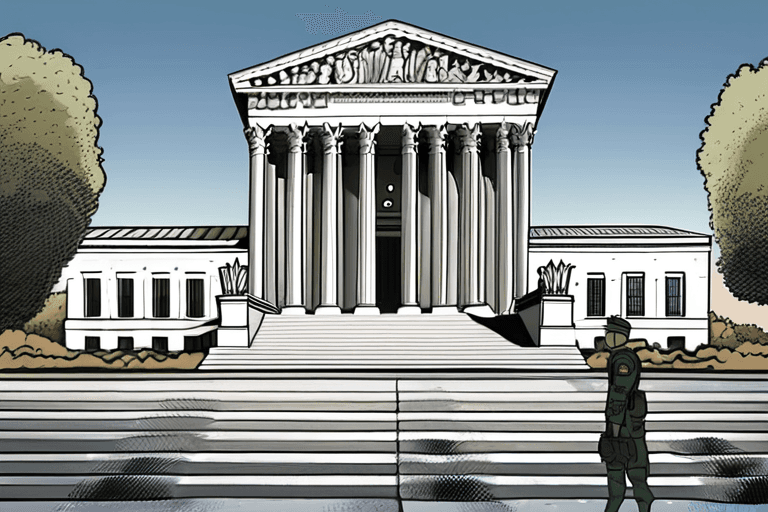
The Supreme Court handed down a significant decision on Tuesday, ruling that President Donald Trump's deployment of National Guard troops to quell protests outside an immigration detention facility in Broadview, Illinois, was a violation of federal law. In a 6-3 decision, three Republican justices joined all three Democratic justices in finding that Trump's actions exceeded his authority under the Insurrection Act.
According to court documents, Trump had deployed a few hundred members of the National Guard to the facility in response to protests by immigration advocacy groups. The protesters were demonstrating against the treatment of migrants at the facility, which is operated by Immigration and Customs Enforcement (ICE). The court found that Trump's actions were not justified under the Insurrection Act, which allows the president to deploy troops to quell domestic unrest in certain circumstances.
"This decision marks a significant limit on the president's authority to use the military against American citizens," said Justice Sonia Sotomayor, who wrote the majority opinion. "We have long recognized that the president's powers are not unlimited, and that the Constitution and federal law impose important checks on his authority."
In a dissenting opinion, Justice Clarence Thomas argued that the court's decision was an overreach of judicial power. "The president has a constitutional duty to protect the nation and its citizens from domestic unrest," Thomas wrote. "The court's decision today undermines that duty and sets a dangerous precedent for future presidents."
The decision is seen as a significant blow to Trump's efforts to assert executive authority, particularly in the area of national security. The ruling also has implications for future protests and demonstrations, which may be subject to stricter regulations and enforcement.
The Supreme Court's decision is the latest in a series of high-profile cases involving Trump's use of executive power. In 2020, the court ruled that Trump's attempt to add a citizenship question to the census was unconstitutional. In 2022, the court blocked Trump's efforts to rescind the Deferred Action for Childhood Arrivals (DACA) program, which provides protections for certain young undocumented immigrants.
The decision in Trump v. Illinois is likely to have significant implications for future presidential actions, particularly in the area of national security. As the court's decision makes clear, the president's powers are not unlimited, and that the Constitution and federal law impose important checks on his authority.









Discussion
Join 0 others in the conversation
Share Your Thoughts
Your voice matters in this discussion
Login to join the conversation
No comments yet
Be the first to share your thoughts!