
AI Insights2m ago
UK social media campaigners among five denied US visas
Multi-source news update

00
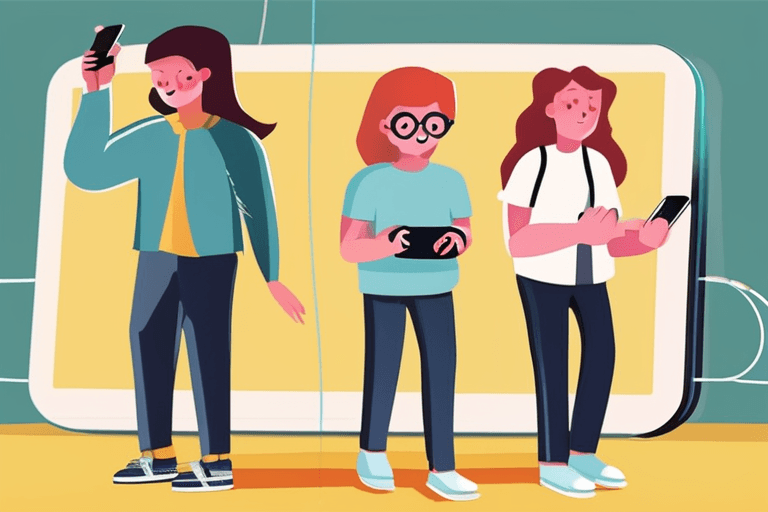
As the sun set on the last day of school before winter break, eighth-grader Aiden found himself in a heated game of Mafia with his classmates. But when one of his friends got bored and quit, Aiden's friend couldn't help but make a pointed comment: "You're such a screenager, your attention span is so short." The jab stung, but it also sparked a conversation that would linger long after the school year ended. Aiden's friend wasn't just making a joke - he was highlighting a growing concern among teens and adults alike: the impact of social media on young people's lives.
In the past five years, the national conversation about young people and social media has shifted dramatically. Gone are the days of worrying about cyberbullying and online harassment; today, the biggest fear is that social media is rewiring young brains to crave constant stimulation and instant gratification. As Aiden's friend so aptly put it, people are "less likely to have fun and enjoy being around other people, and they prefer being around technology."
So, what's behind this phenomenon? And more importantly, how can parents and educators help kids break free from the grip of their screens? To find out, I spoke with several Scholastic Kid Reporters, including Aiden, who shared their own experiences and insights on the impact of social media on their lives.
For Aiden, the problem starts with the way social media platforms are designed. "They're made to be addictive," he explained. "They use algorithms to keep you engaged, and they make it hard to log off." Aiden's friend, who asked to remain anonymous, echoed this sentiment: "I feel like I'm constantly competing for likes and followers, and it's exhausting."
But social media isn't just a problem for individual kids - it's also having a profound impact on society as a whole. According to a recent study by the Pew Research Center, 54% of teens say they spend too much time on their screens, and 60% say they feel pressure to present a perfect online image. This can lead to a culture of comparison and competition, where kids feel like they're constantly falling short.
So, what can parents and educators do to help kids break free from the grip of their screens? One approach is to set clear boundaries and rules around screen time. "We have a family rule that we don't use our phones at the dinner table," said Aiden's mom. "It's not always easy, but it's helped us have more meaningful conversations and spend quality time together."
Another approach is to encourage kids to engage in offline activities that promote social connection and creativity. "We've started a book club at school, and it's been amazing," said Aiden. "We get to discuss books and share our thoughts, and it's really helped me connect with my classmates on a deeper level."
But perhaps the most important thing parents and educators can do is to model healthy behavior themselves. "As adults, we need to be mindful of our own screen use and set a good example for our kids," said Dr. Jean Twenge, a psychologist who has written extensively on the impact of social media on young people. "We need to show kids that there's a world beyond our screens, and that it's worth exploring."
As the winter break comes to a close and kids head back to school, it's clear that the conversation about social media and young people is far from over. But by setting clear boundaries, encouraging offline activities, and modeling healthy behavior, parents and educators can help kids break free from the grip of their screens and discover a world of possibility beyond their screens.
In the words of Aiden's friend, "It's time to put down our phones and start living."
Multi-Source Journalism
This article synthesizes reporting from multiple credible news sources to provide comprehensive, balanced coverage.
Get instant insights & analysis
Discover more articles
Multi-source news update

Article about eleven arrested over mass shooting in south africa tavern


A Democratic board member, Representative Joyce Beatty, has filed a lawsuit to remove President Donald Trump's name from the John F. Kennedy Center for the Performing Arts, claiming the renaming was illegal without Congressional approval. The board, dominated by Trump allies, voted to rename the center in his honor, citing his efforts to strengthen the center's finances and modernize its facilities. The lawsuit argues that the center was intended to be a "living memorial" to President Kennedy, and the renaming undermines its original purpose.


Multi-source news update


Sean 'Diddy' Combs files appeal asking for immediate prison release6 hours agoShareSaveShareSaveReutersJane RosenbergA courtroom sketch of Sean Diddy Combs during his prison sentencing hearing.Sean "Diddy" Combs has asked an appeals court to release him from prison and overturn his conviction on two prostitution-related crimes.In a court filing for an expedited appeal, the rap mogul's attorney argued that he was improperly sentenced, and that the conduct that resulted in his conviction was not criminal in nature.Attorney Alexandra Shapiro called Combs' 50-month prison sentence "unlawful, unconstitutional, and a perversion of justice". She asked an appeals court to order that Combs be resentenced, should the panel choose not to throw out his conviction in its entirety.

In a closely contested Honduran presidential election, Nasry Asfura, backed by US President Donald Trump, has been declared the winner with 40.3% of the vote, narrowly edging out Salvador Nasralla. The election was marred by technical delays and allegations of fraud, prompting protests and controversy, but US Secretary of State Marco Rubio has urged respect for the result. This outcome draws from multiple news sources, including the BBC and Reuters.

Discussion
Join 0 others in the conversation
Share Your Thoughts
Your voice matters in this discussion
Login to join the conversation
No comments yet
Be the first to share your thoughts!