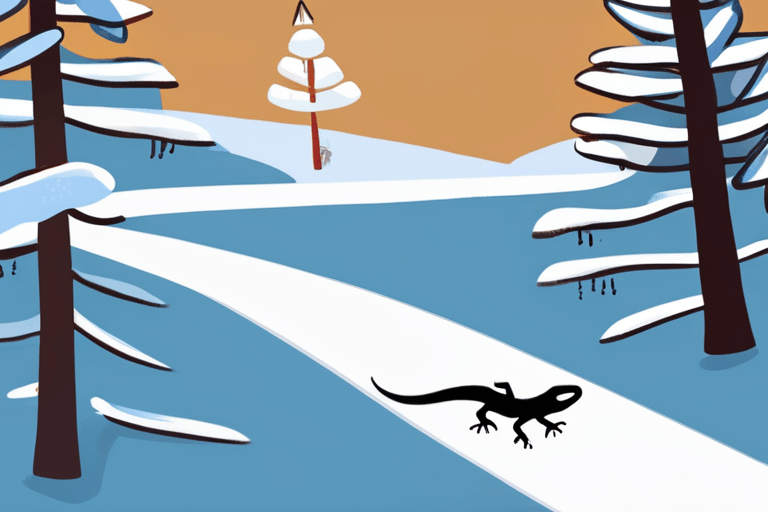
Researchers at Algonquin Provincial Park in Canada's Ontario region observed blue-spotted salamanders remaining active on land despite the freezing temperatures, a phenomenon that has left scientists surprised and intrigued. The salamanders were seen on land at Bat Lake in late winter, a time when the lake was still frozen and ice covered the ground. According to Dr. David Pike, a biologist at the University of Ottawa, who led the research team, "We noticed that okay, there's still ice on the ground, the lake's still frozen, but for some weird reason, there were blue-spotted salamanders on land."
The ability of blue-spotted salamanders to remain active in freezing temperatures is a remarkable phenomenon that has been observed in the wild. These amphibians can survive in temperatures below the normal freezing point of body fluids, a state known as "supercooled." This ability is not unique to blue-spotted salamanders, as some other species of salamanders have also been known to exhibit this trait. However, the observation of this phenomenon in blue-spotted salamanders in the wild is significant, as it provides new insights into the adaptability and resilience of these animals.
The research team, which included scientists from the University of Ottawa and the Canadian Wildlife Service, used camera traps and other monitoring equipment to track the salamanders' movements and behavior. According to Dr. Pike, "We were able to capture images of the salamanders on land, and we also collected data on their behavior and physiology." The team's findings were published in a recent study, which provides a detailed account of the salamanders' ability to survive in freezing temperatures.
The ability of blue-spotted salamanders to remain active in freezing temperatures has important implications for our understanding of the adaptability and resilience of these animals. According to Dr. Pike, "This finding highlights the complexity and diversity of life on Earth, and it challenges our current understanding of the limits of life in extreme environments." The study's findings also have implications for conservation efforts, as they suggest that blue-spotted salamanders may be more resilient to climate change than previously thought.
The study's findings have also sparked interest in the scientific community, with researchers from around the world expressing interest in learning more about the salamanders' ability to survive in freezing temperatures. According to Dr. Pike, "We are already receiving requests for collaboration and data sharing from researchers in other countries." The study's findings are also expected to have implications for the development of new technologies and strategies for mitigating the effects of climate change.
As for the current status of the research, Dr. Pike and his team are continuing to study the salamanders' behavior and physiology in the wild. According to Dr. Pike, "We are planning to conduct further research on the salamanders' ability to survive in freezing temperatures, and we are also exploring the potential applications of this finding in fields such as conservation and biotechnology." The study's findings are expected to have a significant impact on our understanding of the adaptability and resilience of blue-spotted salamanders, and they may also have implications for the development of new technologies and strategies for mitigating the effects of climate change.











Discussion
Join 0 others in the conversation
Share Your Thoughts
Your voice matters in this discussion
Login to join the conversation
No comments yet
Be the first to share your thoughts!