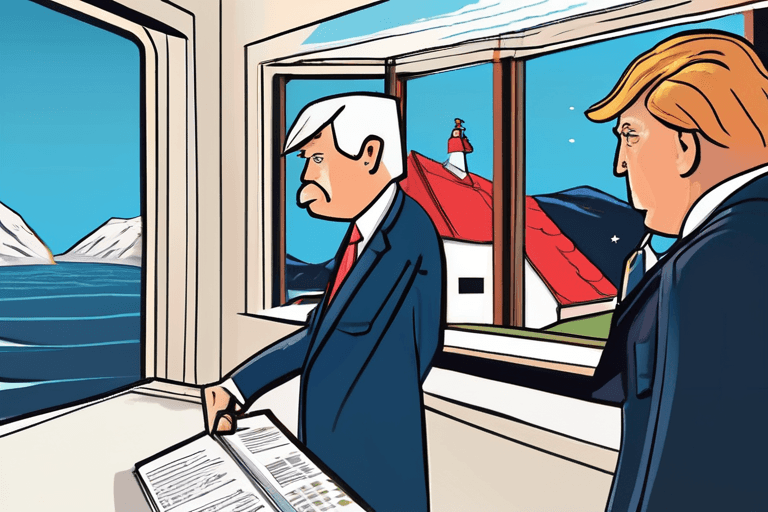
President Donald Trump appointed Louisiana Gov. Jeff Landry as a special envoy to Greenland with the goal of making the territory a part of the United States. According to Landry, the objective is to secure Greenland's status as a US territory, which has been under Danish rule since the 18th century. Trump stated that the US needs Greenland for national protection, a claim that has sparked debate and raised questions about the feasibility and implications of such a move.
In a statement, Landry emphasized the importance of Greenland's strategic location, citing its proximity to the Arctic Circle and its potential for natural resource extraction. However, Greenland's government has been moving gradually toward greater independence, with the territory's prime minister, Múte Bourup Egede, expressing concerns about the potential consequences of US involvement. "We are not for sale," Egede said in a statement, adding that Greenland's future should be determined by its own people.
Greenland's history of Danish rule dates back to the 18th century, when the territory was a Danish colony. In 1953, Greenland became an integral part of Denmark, but in 1979, it gained home rule, allowing it to manage its internal affairs. In recent years, Greenland has been moving toward greater autonomy, with the territory's parliament, the Inatsisartut, playing an increasingly important role in decision-making.
The idea of Greenland becoming a US territory has been discussed in the past, but it has gained renewed attention in recent years due to the Trump administration's interest in the territory's natural resources, particularly its vast mineral deposits. The US has also been concerned about China's growing presence in the Arctic region, with some analysts suggesting that a US presence in Greenland could help counterbalance China's influence.
The appointment of Landry as special envoy to Greenland has been met with skepticism by some, who question the feasibility and wisdom of pursuing such a move. "This is a classic example of the Trump administration's 'America First' approach, where they prioritize short-term gains over long-term consequences," said Dr. Sarah Kreps, a professor of international relations at Cornell University. "The implications of annexing Greenland would be far-reaching and complex, and it's unclear whether the US has the necessary resources and expertise to manage the territory effectively."
As the situation continues to unfold, it remains to be seen whether the US will be able to make progress on its goal of annexing Greenland. The territory's government has expressed its commitment to maintaining its independence, and the international community has been watching the situation closely. In the meantime, the debate over Greenland's future continues, with implications for the territory's people, the US, and the global community.










Discussion
Join 0 others in the conversation
Share Your Thoughts
Your voice matters in this discussion
Login to join the conversation
No comments yet
Be the first to share your thoughts!